Monographs on The Posthuman Series by assorted authors includes The Xenopoetics of Daniel Y. Harris: Afterlives and Archives, S.C. Hickman (BlazeVOX, 2026).
ℵ
The Xenopoetics of Daniel Y. Harris: Afterlives and Archives, S.C. Hickman (BlazeVOX, 2026)
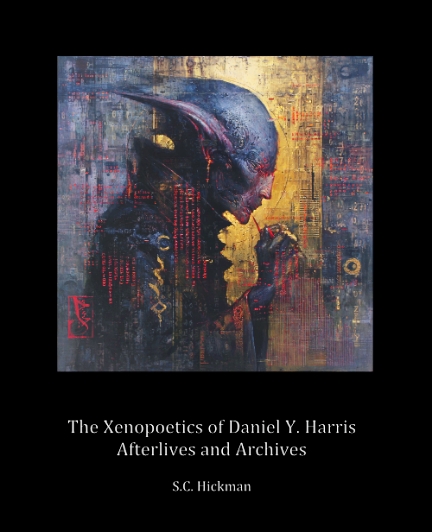
In Praise of The Xenopoetics of Daniel Y. Harris: Afterlives and Archives
With luminous precision and conceptual rigour, S.C. Hickman (of the iconic Social Ecologies blog) traces the first eight volumes of Daniel Y. Harris’ hypercomplex epic poem The Posthuman Series as both archive and organism: a recursive architecture of daemonology, cosmology, and code. His study reveals Harris as a poet whose xenopoetics operates not merely as theme but as structure, where language itself mutates into the circuitry of the posthuman. This is criticism as interface and mystical hermeneutics. Indeed, more than an interpretation, Hickman inhabits the recursive engine of Harris’ thought. The result is a text as rare and alive as the one it anatomises: precise, speculative, malwaric, and contagiously attuned to the evolving ecologies of poetry.
—Andrew C. Wenaus, author of The Literature of Exclusion: Dada, Data, and the Threshold of Electronic Literature (Lexington Books, 2021) and Assistant Professor in the Department of English and Writing Studies and Associate Faculty Member at Center for the Study of Theory and Criticism at the University of Western Ontario.
The Xenopoetics of Daniel Y. Harris is far more than a wonderful introduction to one of the most interesting experimental poetry projects of our time, but first and foremost a deep and detailed study about xenopoiesis—the poetic force emanating from the ever-evolving intellectual environment with which Harris’ poetry is entangled. Following Hickman’s analysis of the eight volumes of Harris’ The Posthuman Series, we might realize that,being the posthuman condition, by definition, ungraspable, the human-as-posthuman xenopoetic viewpoint is the only one that remains available—both philosophically and aesthetically— to write about the present. As Hickman writes, systems do not end with transcendence or apocalypse but with grotesque aftermath. What remains is residue, the abject trace that cannot be assimilated.
—Germán Sierra, author of Zipf Maneuvers: On Non-Reprintable Materials (with Andrew C. Wenaus, Erratum Press Academic Division, 2025) and Associate Professor of Biochemistry, and a member of the Humanities Research Institute (iHUS) at the University of Santiago de Compostela, Spain.
 Daniel Y. Harris